
How much energy does a cinema projector consume? While it’s not 1.21 gigawatts, energy consumption remains an important consideration when picking the right projector for your cinema. In recent years, the industry shifted to using laser projectors, which are more efficient than their Xenon predecessors at turning wattage into lumens. Below are key environmental and efficiency considerations for the three main illumination options: Xenon, hybrid laser and RGB pure laser projectors.
Energy consumption for projectors is measured in lumens per watt (lm/W), which indicates how many lumens are generated from a watt of power.
For decades, Xenon lamps have set the industry standard with roughly 4.5 lm/W; however, modern laser technologies are far more efficient. RB laser phosphor projectors typically produce 9 lm/W, whereas RGB hybrid projectors reach 14.8 lm/w and RGB pure laser models produce up to 14.5 lm/W.
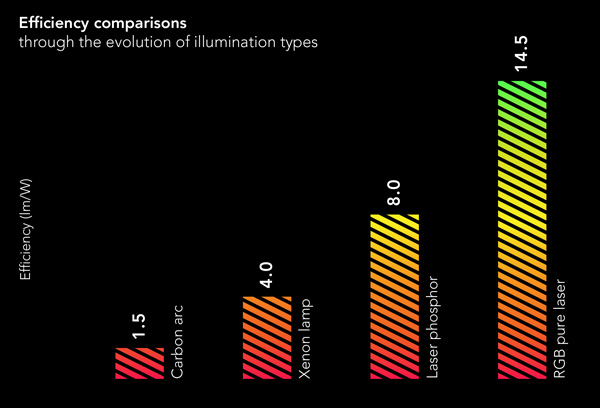
Xenon projectors have been a stalwart in theatres for over 40 years, but they rely on gas-filled lamps that produce excess waste heat and require periodic replacement. Modern laser projectors not only require less maintenance and energy, but they also offer enhanced efficiency for various screen sizes.
Hybrid projectors are ideal for smaller screens with less than 20,000 lumen requirements, while energy-efficient RGB pure laser projectors offer even greater lumens per watt and reduce environmental impact for screens that require more than 20,000 lumens.
Further efficiency
Laser changed the total cost of ownership (TCO) for exhibitors entirely. Not only is it much more efficient, but it requires less maintenance, produces less heat, and uses fewer consumable components – namely, lamps. Exhibitors have become accustomed to replacing Xenon lamps every 2,000 – 3,000 hours. Laser projectors do not require a light source replacement until they reach 50,000 hours. All told, the annual CO2 emissions reduction found in switching from Xenon projection to laser is up to 28.9 tons or the equivalent to removing 5 gas-powered cars from the road.